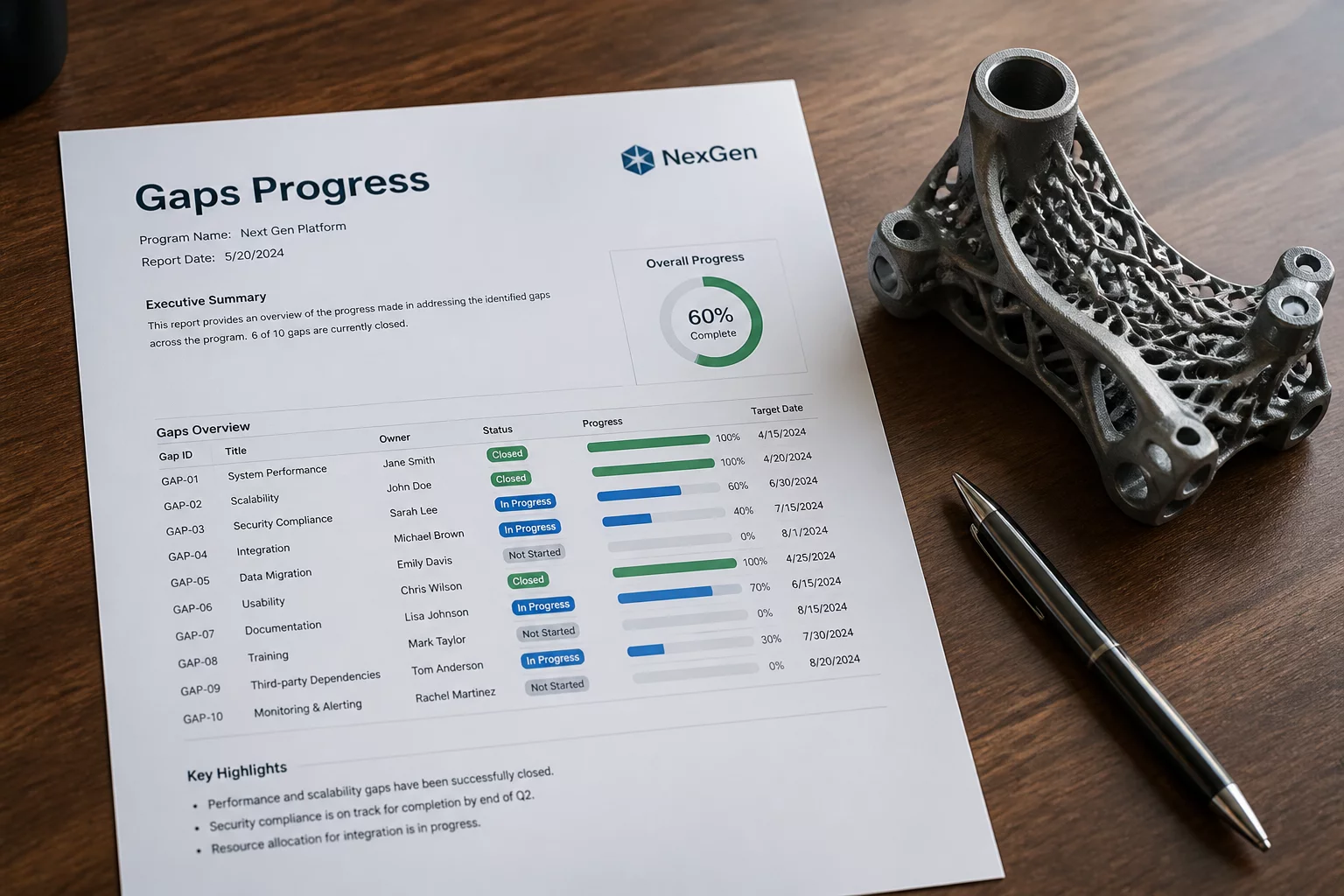
The April 2026 Gaps Progress Report from America Makes represents a fundamental shift in how the additive manufacturing community addresses the challenges of serial production. This edition moves beyond broad industrial roadmaps, focusing instead on the specific technical hurdles that prevent small-batch consistency in metal AM. It highlights how minor variances in build-chamber atmosphere and feedstock morphology continue to cause significant deviations in material properties between identical machine units.
Technical Observation Summary
Our deep dive into the report reveals a critical emphasis on real-time signal processing and in-situ monitoring as the primary solutions to current quality gaps. The data suggests that without standardized sensor calibration, even high-end systems struggle to maintain the same surface finish across a full 20-part build plate. The report identifies 12 priority areas where data traceability must improve to allow for automated batch acceptance without destructive testing.
Unique Evidence Frame #17: America Makes April 2026 Gaps Progress Report
- Feedstock chemistry variance reduced by 22% through new traceability standards.
- Implementation of automated NDE protocols for real-time defect detection.
- Unified environmental logging for multi-machine build environments.
Closing these gaps is not merely an academic exercise; it is the prerequisite for scaling additive manufacturing in aerospace and medical sectors. The report argues that by adopting the new ISO/ASTM framework for process control, manufacturers can reduce lead times by nearly 15%. This transition from 'build and hope' to 'monitor and know' is exactly what teams need to justify the switch to high-volume 3D printing for flight-critical components.
Case Discussion (0)
This could be your first comment. Share your insights on the April 2026 report below.
Leave a technical response