Batch Control Methodology
To achieve true repeatability in additive manufacturing, we must first define what "normal" looks like. Our methodology focuses on isolating environmental noise from systemic machine failure, ensuring that every batch meets rigorous quality standards.
Defining Within-Batch Variation
Within-batch variation refers to the measurable differences between parts produced in the same print run. While no two parts are identical, a healthy production process exhibits a tight clustering of metrics. When the distribution widens, it signals a breakdown in thermal stability, material consistency, or mechanical synchronization.
The Control Threshold
We utilize the Coefficient of Variation (CV) as our primary health metric. A CV below 1.5% is considered "Green" (Optimal), while anything exceeding 3% triggers an immediate root-cause investigation.
- < 1.5%: Stable Environment
- 1.5% - 3.0%: Process Drift Detected
- > 3.0%: Batch Critical Failure
The Three Pillars of Measurement
Dimensional Accuracy
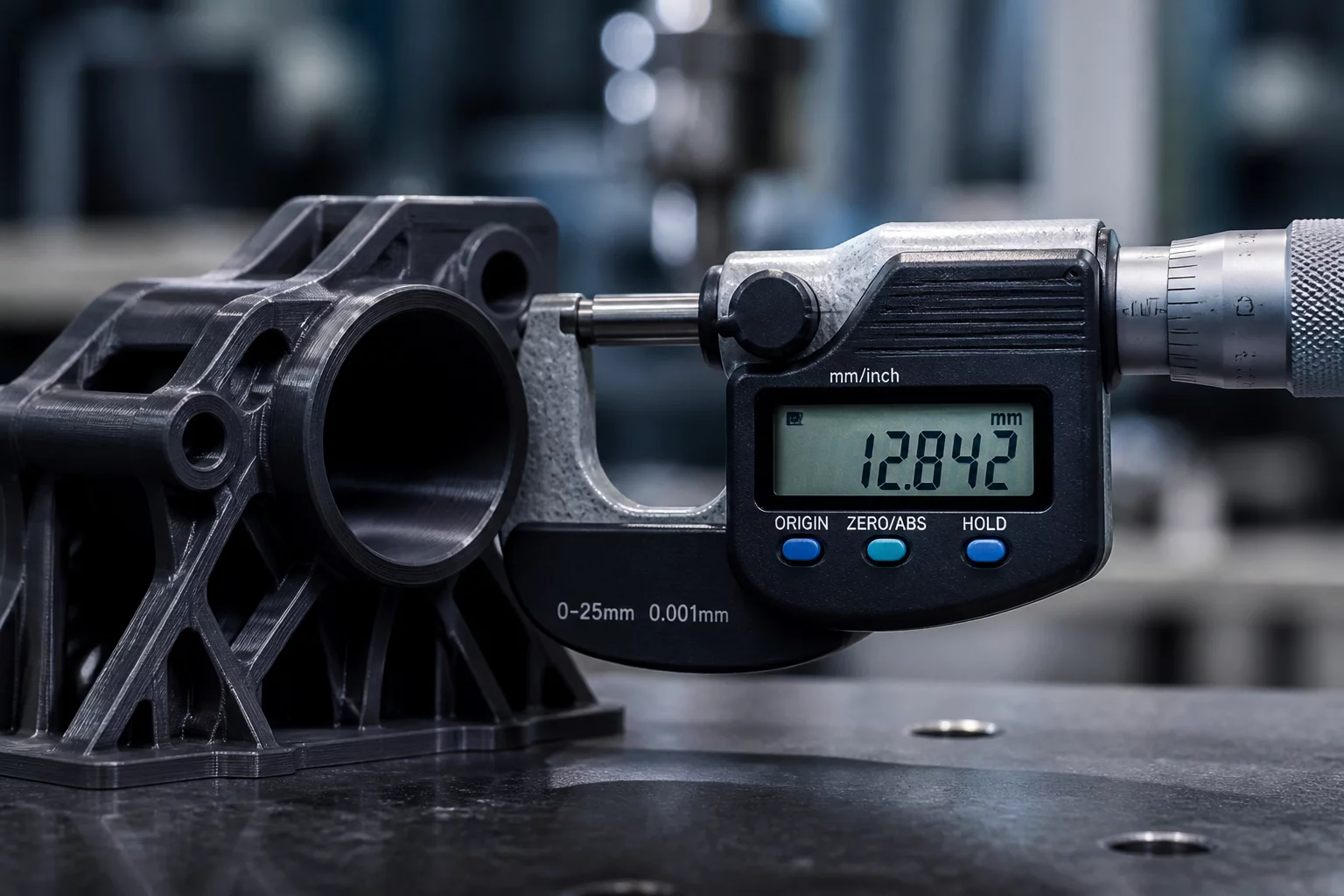
Measurement of X, Y, and Z axes using digital micrometers with a resolution of 0.001mm. We track expansion and contraction rates across different build plate zones.
Mass Consistency
Weight analysis of completed parts to detect internal voids or extrusion inconsistencies that are not visible to the naked eye.
Surface Topology
Visual and digital auditing of layer adhesion and surface roughness (Ra) to ensure cosmetic and structural uniformity.
Interactive Batch Health Calculator
Test your own production data. Enter up to 5 measurements (e.g., weight in grams or dimensions in mm) to calculate the variation and determine the health of your current batch.
Results will appear here after analysis.