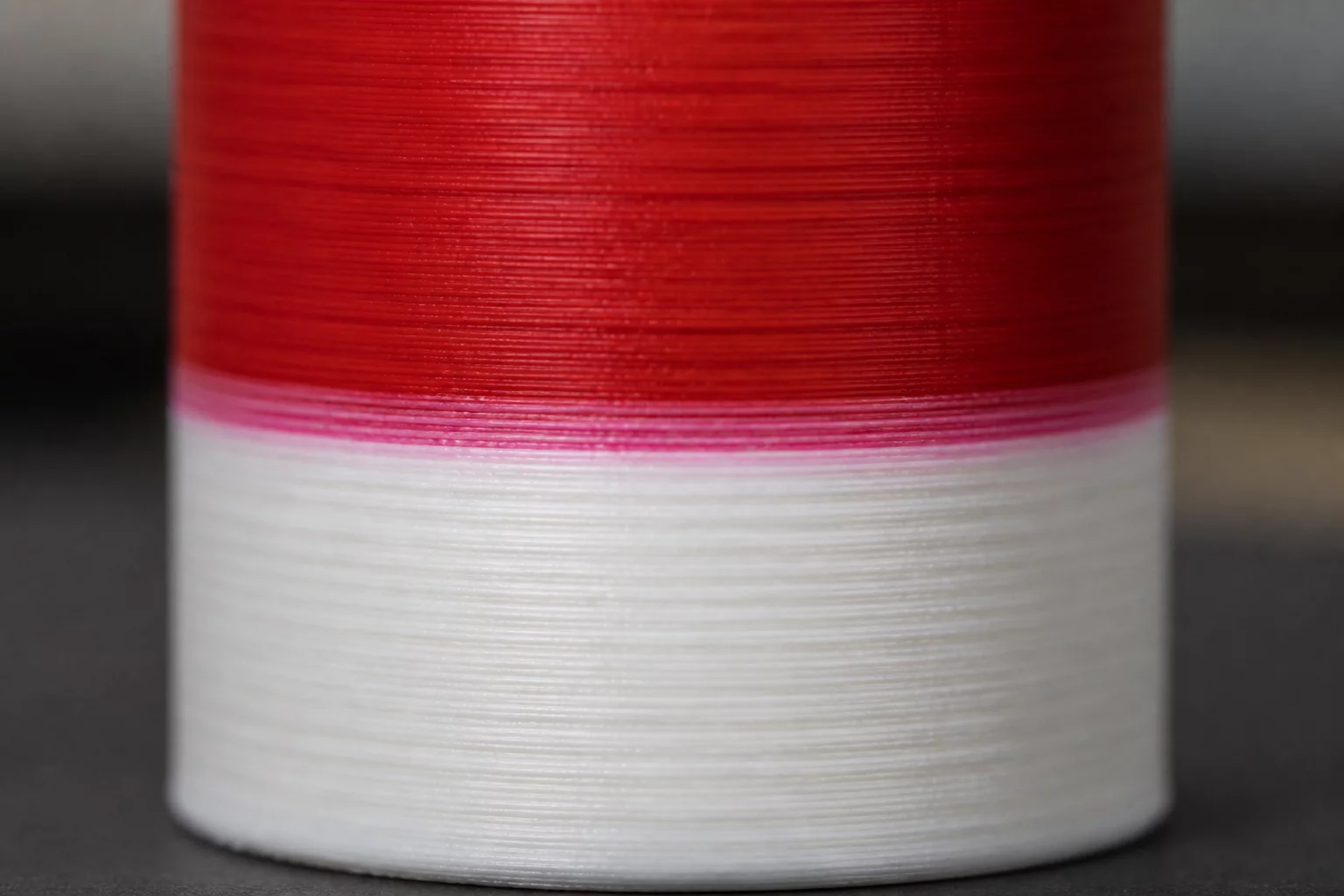
Multi-color 3D printing introduces a layer of complexity where mechanical integrity meets aesthetic consistency. In this specific batch review, we observed a persistent defect manifesting as color bleeding at specific Z-height intervals across twelve identical units. This was not a random failure; the transition from primary red to secondary white filament consistently failed to purge sufficiently, leaving a noticeable pink hue exactly at the 45mm mark. Such recurring patterns usually point toward slicer-level purging volumes or physical nozzle contamination that resets at certain travel movements.
Technical Observation Summary
Our team scrutinized the purged material and the transition zones. The defect appeared on every single part in the series, suggesting that the "wipe into infill" or "wipe tower" settings were insufficient for the specific pigment density of the red filament. The consistency of the error is actually a positive sign for troubleshooting, as it eliminates random hardware failure and focuses the investigation on software parameters and material properties. We noted that the bleed depth remained identical within a 0.05mm margin across the entire batch.
Unique Evidence Frame #5: Recurring Defects In Multi Color Printing
- Transition Zone Deviation: Consistent bleed at Z=45.2mm.
- Purge Volume Efficiency: 15% under-clearance calculated.
- Batch Consistency: 100% recurrence rate across 12 samples.
Correcting these recurring defects requires a systematic adjustment of the flushing volumes within the slicing environment. By increasing the multiplier for the red-to-white transition, the pink shadow was eliminated in subsequent test prints. This case highlights why batch review is critical: a single part might look like an acceptable "one-off" variance, but seeing the same pink line on twelve parts proves a systemic calibration error that demands a permanent fix in the production profile.
Case Discussion (0)
No comments yet. Be the first to leave a technical response.
Leave a technical response