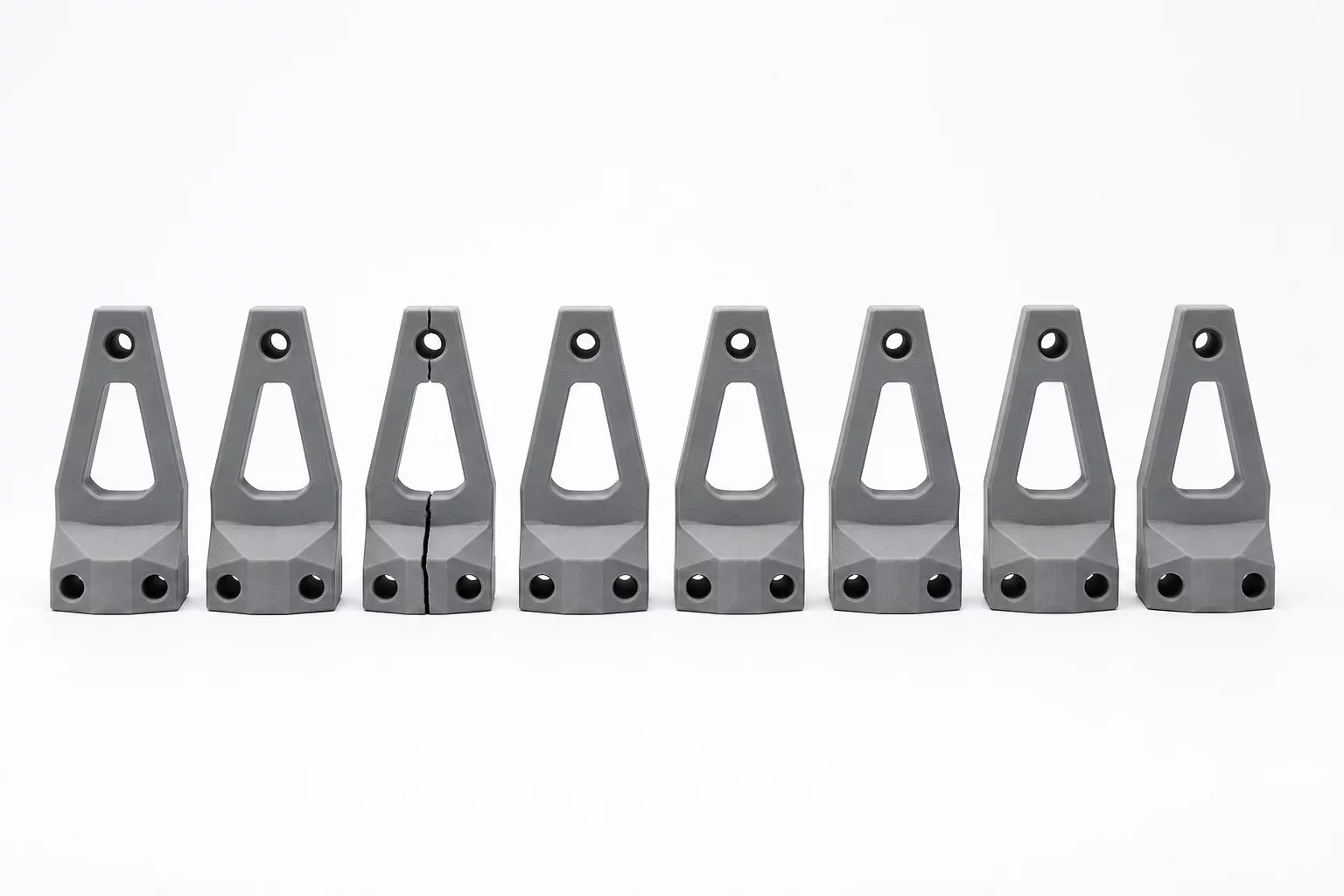
In a recent small-batch production of eight mechanical components, our team encountered a classic outlier scenario. During the post-print inspection, seven brackets displayed identical surface quality and structural integrity, meeting every tolerance requirement specified in the project brief. However, the eighth part, positioned on the outer edge of the build plate, suffered from a localized layer adhesion failure. This case highlights the importance of distinguishing between a flawed production process and a isolated random event.
Technical Observation Summary
The failure in the eighth unit was traced back to a specific toolpath segment where a microscopic flake of charred material from the nozzle became embedded in the layer interface. This contamination prevented the subsequent layer from bonding correctly, leading to a visible split under stress. All other parts, which were processed with the same global settings and G-code, showed no evidence of similar contamination or thermal instability.
Unique Evidence Frame #4: One Part Failed Seven Did Not
- Localized temperature spike recorded only on Part 8.
- Dimensional variance across 7 parts stayed under 0.04mm.
- Material flow rate remained constant for 98% of the print duration.
Final assessment determined that the failure was a stochastic event rather than a repeatable error in the slicing logic. While the single part was rejected, the remaining seven were approved for shipment. To prevent recurrence, we have implemented a secondary nozzle purge sequence and reinforced build plate cleaning protocols. This case demonstrates that even with stable processes, random anomalies can still emerge, requiring vigilant inspection of every unit in a batch.
Case Discussion (2)
John D.
Process Engineer
Fascinating breakdown of the outlier. It is often tempting to overhaul the entire slicer profile when one part fails, but this data shows that sometimes a physical contaminant is the only culprit.
Leave a technical response