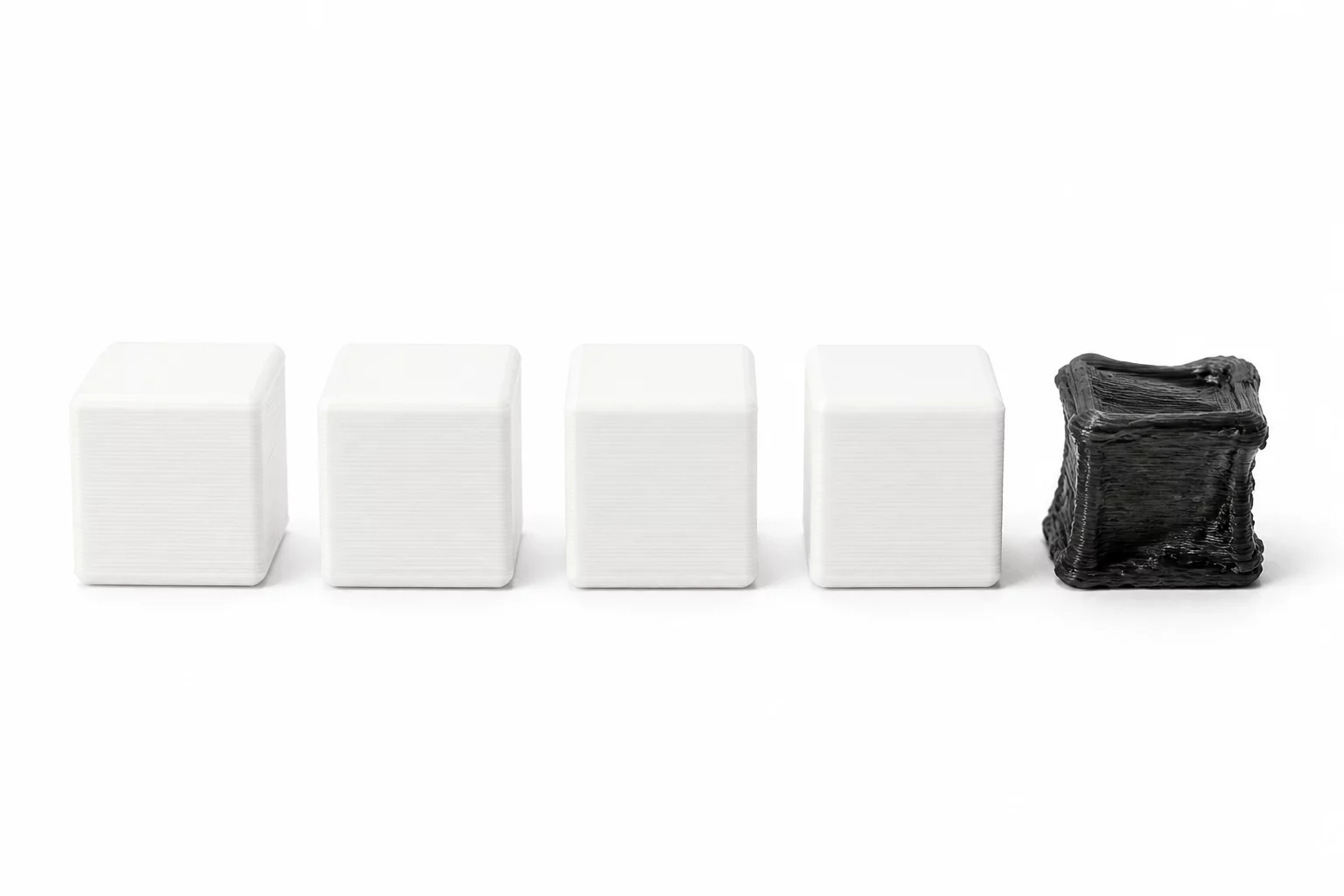
In the high-stakes environment of industrial additive manufacturing, early success is often the most dangerous form of feedback. This case study details a serial production run of twelve identical mechanical housings where the initial eight units exhibited exceptional quality. Based on the early data, the production line was nearly cleared for a long-term automated run. However, Sample #9 introduced a dramatic shift in thermal stability that forced a complete re-evaluation of the entire batch's integrity.
Technical Observation Summary
The critical failure identified in the later samples was linked to cumulative heat retention within the build chamber during a six-hour continuous print window. While the active cooling fans managed the geometry of the first few parts effectively, the ambient temperature of the enclosure steadily climbed. By the time Sample #9 was being processed, the localized cooling was no longer sufficient to prevent slight warping on the internal overhangs. This cumulative drift suggests that a passing grade on Sample #1 does not guarantee consistency for the remainder of the build volume.
Unique Evidence Frame #1: A Later Sample Changed The Final Decision
- Thermal accumulation delta of +4.2°C recorded between the start and end of the print cycle.
- Z-axis dimensional deviation increased from 0.02mm to 0.18mm across the twelve-part sequence.
- Significant surface roughness (Ra) shift from 3.2μm to 7.8μm on critical internal fluid channels.
Final rejection of the latter four units saved the client from potential field failures. By analyzing the entire series as a single dataset rather than isolated parts, we identified that the process was fundamentally unstable over long durations. This case underscores the necessity of continuous monitoring; without the inspection of the very last sample in the sequence, the repeatability problem would have remained hidden, leading to a catastrophic failure in the assembly phase.
Case Discussion (0)
No technical observations yet. This could be your first comment.
Leave a technical response