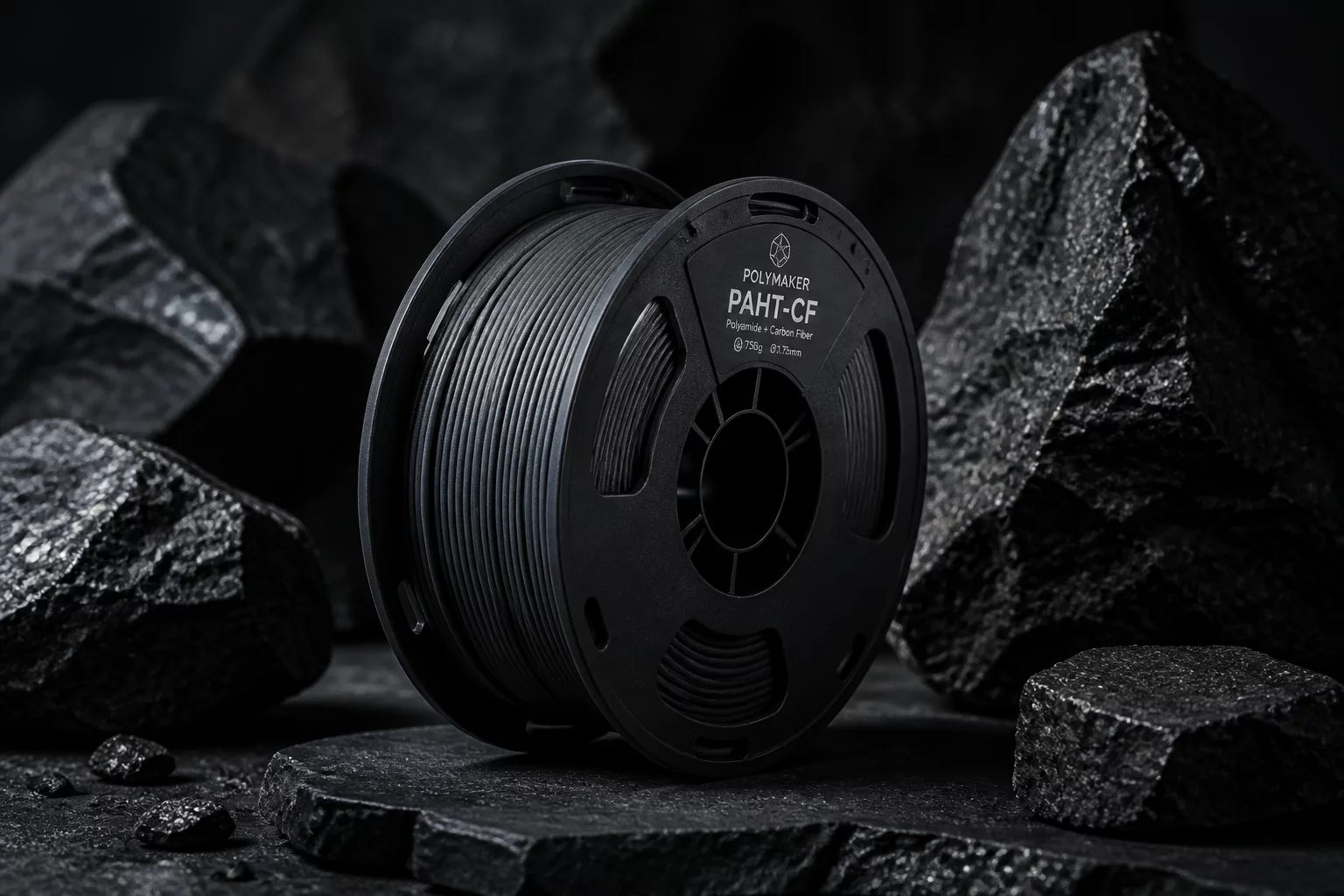
Voltage has officially launched its Eclipse X9 Basalt PETG, a composite material designed for high-performance additive manufacturing. By integrating crushed basalt fibers into a refined PETG matrix, the company aims to bridge the gap between standard polymers and high-cost industrial filaments. Our testing focus centered on the material's claim of superior dimensional stability across serial production runs. Unlike carbon fiber alternatives, basalt offers a unique thermal profile that demands precise cooling adjustments, yet rewards the user with a matte, rock-like finish that effectively hides layer lines.
Technical Observation Summary
During our evaluation phase, we processed multiple separate batches of the Eclipse X9. The primary observation was the exceptional interlayer adhesion, which remained consistent even when ambient chamber temperatures fluctuated. The basalt reinforcement acts as a thermal stabilizer, allowing for reliable printing speeds without the usual risk of corner warping common in large-format PETG prints. However, the abrasive nature of the basalt fibers requires a hardened steel nozzle, as standard brass units showed significant diameter wear after just half a kilogram of extrusion.
Unique Evidence Frame #15: Voltage Introduces Eclipse X9 Basalt Petg
- Tensile Strength: 58 MPa (±2.1 MPa variation across 10 samples)
- Heat Deflection Temperature: 82°C at 0.45 MPa
- Surface Roughness: Ra 3.2μm (Consistent matte finish across batch)
For teams operating in small-batch production, the Eclipse X9 represents a stable choice. The variance in shrinkage rates between the first and last spools of a single production lot was measured at less than 0.05%, which is remarkably low for a composite material. While the price point sits higher than standard PETG, the reduction in failed prints due to warping provides a clear return on investment. We recommend a nozzle temperature of 245°C and a bed temperature of 80°C to achieve the optimal balance between flow rate and structural integrity.
Case Discussion (2)
Alex B.
AM Specialist
Basalt composite sounds interesting.
Chris M.
Quality Auditor
Wonder how it handles large batches.
Leave a technical response